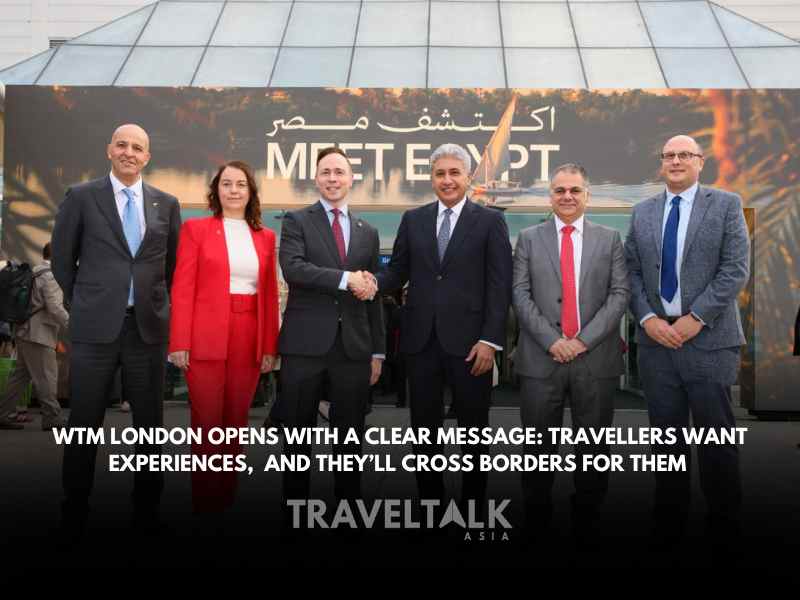
WTM London 2026 opened with some of the travel industry’s biggest debates taking centre stage, led by the launch of WTM’s Global Travel Report, in association with Tourism Economics, alongside a newly structured conference programme.
Due to its growing popularity, the press conference launching the Global Travel Report’s findings was live streamed from the International Media Centre to all four of the event’s main stages.
Dave Goodger, managing director for Tourism Economics noted that the erosion of consumer spending power was an ongoing issue, but the bigger picture is that “travellers are reallocating resources and looking to save where they can.”
Sean Morgan, head of travel research at Tourism Economics also pointed out that 60% of travellers surveyed for the report wanted “luxury” holidays, where experiences are key.
Luxury and experiences were common themes elsewhere across Day 1 of the show. Chase Gray from Skift Advisory framed luxury as one of the “values” that its research identified as being relevant for the traveller of the future, specifically, 2036. However, he said that luxury will be about “access not excess”, and that “prestige travellers, who “want to see and be seen” were one of three cohorts who travel companies should plan ahead for.
The other two types of traveller he identified want “enrichment”, as in growth and personal development, and “connection” across family groups and friendship circles.Experience is such an important part of tourism it now has a dedicated hub at WTM London.
In The Experience Economy: Niche is the new mainstream, Angela Val, from Visit Philadelphia, emphasised the economic opportunity in building immersive tie-in activities and itineraries around key events, focusing on Taylor Swift. “That has really changed the way we look at concerts in Philadelphia,” she said. “It has become normal for people to go to a concert and want to experience something outside of it… to embrace it for the three days [they’re] there.”
Philadelphia seized a similar opportunity by mounting a range of free fringe events during this year’s FIFA World Cup. In fact, its Fanfest was the most attended of the tournament, pointing out that “70% of people who go to the World Cup don’t have a ticket”.
A similar theme exploring experiential tourism and how it drives business and revenues beyond the experience itself emerged on the Trends stage in a panel debate covering “passion tourism” – music, sports and cultural events. Luiza Fortuna from Superstruct Entertainment shared some data about Awakenings, an annual techno festival in the Netherlands it owns and organises. “The audience is pretty much a 50-50 split of Dutch and international visitors. But of these international guys, 80% of them say that they wouldn’t go to the Netherlands if it was not for the festival”.
The Global Trends Report found that 58% of international travelers have undertaken a trip abroad specifically to attend an event in the past two years.
Cruise lines are also seeing an uptick in experience-led tourism. China-based luxury river cruise brand Century Cruises used the first day of WTM London to outline its plans for expansion in Europe and North Africa. It introduced a Rhine-Danube ship this year, with another due in 2027 and Nile cruises will be added in 2028. Its plans include enhanced culinary experiences, frequent onboard cultural celebration evenings and exclusive onshore events, such as private opera recitals in Vienna.
David Fredericks, President and CEO for the Americas for Century Cruises explained: “If we were a hotel brand, we would fashion ourselves after Mandarin Oriental or Shangri La.” He added that Century Cruises, which typically hosts Asian, European and American travellers, was happy to collaborate on charters for the MICE market.
Century Cruises, as a growing and emerging business, has identified its target markets as most travel firms do. But Spain, already established as a global leader in international tourism, has identified accessible tourism as a way to not only increase its market share but also improve the experience for visitors with accessibility issues.
The Spanish Tourist Office today launched a hotel advice guide and a series of social media ads created as part of its Spain for All accessibility strategy.
For the past three years, the initiative has seen the office work with an advisory council with members from across the UK and Spanish travel industries, many with lived experience of disability.
“Today we’re publishing a report which gives hotels in Spain and around the world the tools they need to communicate how accessible they are,” Spanish Tourist Office UK Director, José Manuel de Juan González announced.