
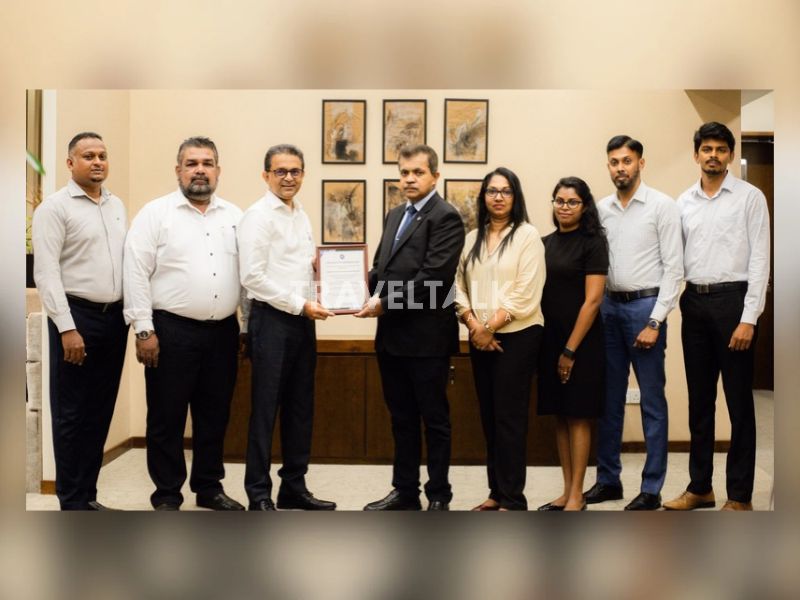
Newburgh Ella – The Tea Factory Resort, by Browns Hotels & Resorts, has been recognised by the National Cleaner Production Centre (NCPC), Sri Lanka, as the first hotel in Sri Lanka to achieve a certified paperless operation, marking a significant milestone in the country’s journey towards more resource-efficient and digitally enabled hospitality.
The certification was formally presented by Samantha Kumarasena, Director General/CEO of the National Cleaner Production Centre, Sri Lanka, to Mr. Eksath Wijeratne, CEO of Browns Hotels & Resorts, recognising Newburgh Ella’s achievement in establishing a paperless hotel operation.
The recognition is particularly significant for Newburgh Ella, a 41-room resort housed within a former tea factory dating back to 1903. A building that once relied on handwritten ledgers, registers and paper records to document the daily movement of tea now operates through digital systems across guest services and hotel operations.
Newburgh Ella’s paperless approach extends far beyond replacing printed menus or introducing digital check-in. The hotel has digitised processes across departments, creating a connected system that allows information, approvals, monitoring and documentation to move digitally throughout the operation.
Guests can complete their registration digitally, access dining menus electronically and receive bills and folios without printed documents. In finance and administration, approvals, records and documentation are managed through digital systems, reducing the need for physical files and paper-based circulation.
The digital approach continues across the operational departments. Engineering teams use digital systems to monitor areas such as electricity consumption, allowing usage to be recorded and reviewed efficiently. In the kitchen, chefs record temperature checks digitally, creating an accessible record for food safety monitoring and audits. Housekeeping teams use digital devices to manage and record their daily activities, while stores and inventory processes are also systemised digitally, allowing stock movements and related documentation to be maintained electronically rather than through multiple physical registers.
The same systems make routine compliance and audit documentation more efficient. Since operational information is recorded within structured digital systems, teams can access records when required without searching through physical files, while managers can monitor processes and maintain documentation in a consistent and traceable manner.
“Newburgh Ella was created to give a historic property a new chapter without losing what makes it special. The paperless operation is part of that thinking. We have looked at the way a hotel works, from the guest journey to the back office, and challenged ourselves to remove unnecessary paper wherever technology allows us to do so. Having this work recognised by the National Cleaner Production Centre is an important milestone for Browns Hotels & Resorts,” said Eksath Wijeratne, CEO of Browns Hotels & Resorts.
The initiative has also been approached as a measurable resource-efficiency programme. Based on Newburgh Ella’s internal tracking of paper and stationery consumption and comparison with conventional paper-based hotel operations, the transition is estimated to avoid approximately 1.3 tonnes of CO₂ equivalent annually. The tracking covers key operational areas including front office, finance, food and beverage and administration.
The recognition by the National Cleaner Production Centre reinforces Newburgh Ella’s position as an example of how a heritage property can embrace technology and more resource-conscious ways of operating while preserving the character and stories that give it its identity.
More than a century after its establishment, Newburgh Ella is bringing together the heritage of Sri Lanka’s tea country with a modern approach to hospitality, demonstrating how a historic property can be preserved physically while its way of operating evolves for the future.