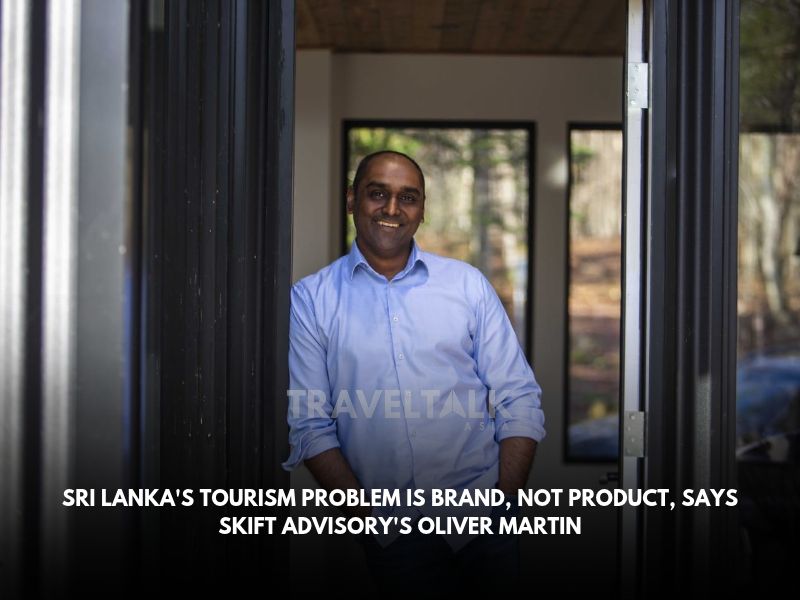
Sri Lanka’s tourism industry is not held back by what it offers visitors but by how it presents itself to the world, Oliver Martin, Senior Director with Skift Advisory, told delegates at the Institute of Hospitality’s International Hospitality Leaders Conference at Cinnamon Grand Colombo. In a data-driven presentation, Martin argued that fragmented positioning, underfunded promotion and scattered market focus have pushed the island down global travel consideration lists. He said this has left visitor yield at roughly half that of comparable island destinations.
Falling behind competitors
Martin placed Sri Lanka at around 81st globally in traveller consideration, behind direct competitors including Thailand, Turkey, Egypt, Greece, the Maldives, Oman and Cambodia. Perception tracking from 2021 through 2026 shows awareness and overall impression falling, interest flat, and Net Promoter Score declining. He said this signals that brand equity is eroding even among travellers who already know the destination.
The gap is clearest in spending. The average visitor to Sri Lanka spends about US$1,300 per trip. That compares with roughly US$3,000 in the Seychelles, US$2,600 in the Maldives and US$1,700 in Mauritius, despite Sri Lanka offering a comparable or richer experience.
Six brands in 25 years
Martin traced the problem to instability at the top. Sri Lanka has cycled through six or more brand positionings over 25 years without sustained funding or focus, which has confused consumers, media and the travel trade alike.
Promotion is also spread thin: around US$12 million is divided across some 17 markets. By comparison, better-funded competitors concentrate on fewer markets, with Destination Canada focusing on about nine and Fiji on about eight. The result, he said, is that operators chase price-sensitive volume and fall into a race to the bottom on price.
Lessons from other destinations
Martin pointed to destinations that have succeeded through consistency and focus:
- New Zealand rebuilt yield through more than a decade of a single, unchanged brand platform.
- Saudi Arabia expanded its brand beyond religious tourism into events, lifting traveller value 2.6 times.
- Fiji positioned itself around culture, cuisine, adventure and wellness and achieved around 10 percent higher yield. Martin noted that this model transfers well to Sri Lanka.
The way forward: from volume to value
Martin set out a strategic pivot built on the “culture-led traveller,” a segment defined by values, life stage and interests rather than nationality. He recommended these steps:
- Adopt a single, emotive, culture-centred brand story that brings together Sri Lanka’s food, history, service, adventure and wellness, and end the cycle of repositioning.
- Increase promotional funding and concentrate it on fewer priority markets where culture-led travellers are most concentrated. Agentic AI can help reach this segment cost-effectively across geographies.
- Measure yield, NPS and consideration every quarter to keep the strategy accountable.
- Have operators align pricing and packaging with the culture-led proposition, while government provides the enabling environment.
Martin noted that improved airlift matters but is not the decisive constraint for this traveller segment.
The presentation gave Sri Lanka’s hospitality leaders a clear message: the country already has the product, and what it needs now is brand discipline and the investment to back it.