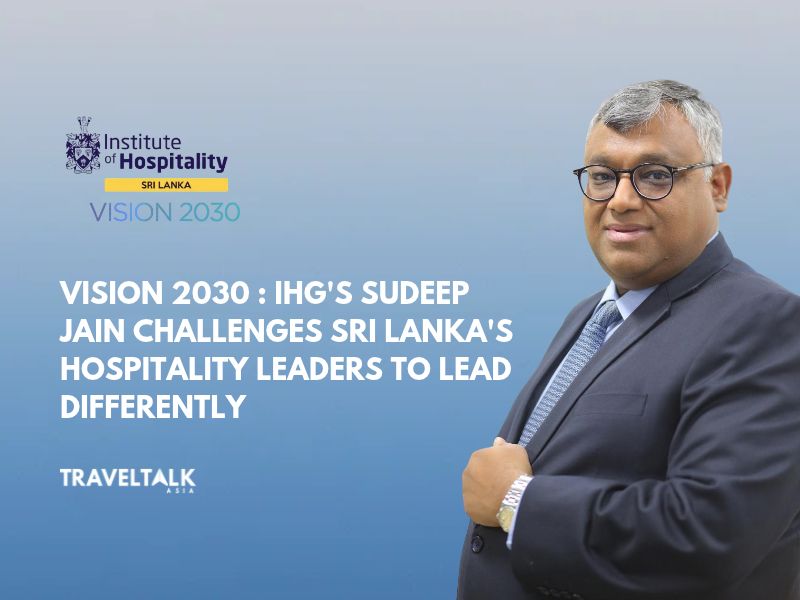
As Sri Lanka’s tourism industry rides a wave of renewed confidence while still facing real volatility, hotel leaders must shift from trying to have every answer to steering a complex ecosystem of stakeholders. That was the message from Sudeep Jain, Managing Director, South West Asia, IHG Hotels & Resorts, who delivered the keynote at the Institute of Hospitality Sri Lanka’s International Hospitality Leaders Conference, Vision 2030, at Cinnamon Grand Colombo.
Speaking to an audience of senior hoteliers and tourism professionals, Jain described the modern hotel as an ecosystem.
Owners seek returns, brands seek consistency, colleagues seek purpose and growth, guests want value and authenticity, and governments and communities expect real economic and social contribution. Technology is reshaping every one of these relationships.
- Resilience means changing course. Jain said resilience is not simply surviving a crisis. It is recognising when a plan has stopped working and having the courage and capability to change it. For Sri Lanka, which has repeatedly rebuilt its tourism story, this lesson carries special weight.
- Governance should create speed, not red tape. In uncertain times, organisations tend to add approvals, committees and freezes, which often weakens accountability. Good governance makes clear who decides, who is consulted, what guardrails apply and who is accountable. Boards own strategy and major risk, management owns decisions within agreed limits, and the front line must have the authority to act.
- Empowerment is not unlimited freedom. It rests on clear objectives, boundaries, ownership and trust, so teams can act decisively within known limits.
- The destination is the experience. In markets like Sri Lanka, where the destination sits at the heart of the guest experience, global non-negotiables must work alongside local expression. Safety, ethics, integrity and brand promise stay fixed. Experience delivery, community engagement and destination storytelling must reflect local realities.
- There is no single market. South West Asia spans gateway cities, emerging business hubs, leisure escapes, spiritual tourism, cricket and concert tourism, and airport-led developments. Each needs a tailored approach.
- Manage the three clocks. Leaders must balance tonight’s guest arrivals, this year’s budget and owner commitments, and the next five to ten years of people, brand, destination and competitiveness. “The danger is that tonight’s clock consumes the other two,” Jain cautioned.
- Technology must strengthen humanity. AI is already transforming forecasting, revenue management, workforce planning and personalisation. The real leadership question is what should remain deliberately human: listening, judgment and relationships. “Memorable hotel experiences are created by people, not software,” he said.
- The front line must reach the boardroom. Frontline colleagues spot problems, trends and opportunities long before executives do, and their insights must flow upward to decision-makers.
By 2030, he said, successful organisations will make decisions closer to the guest and use governance to enable speed. They will blend global standards with local intelligence and operate as integral parts of their destination, community and economy.
“A leader is not measured by how many decisions reach his desk,” Jain concluded. “Our role is to create the conditions for the organisation to run itself intelligently, responsibly and with purpose.”